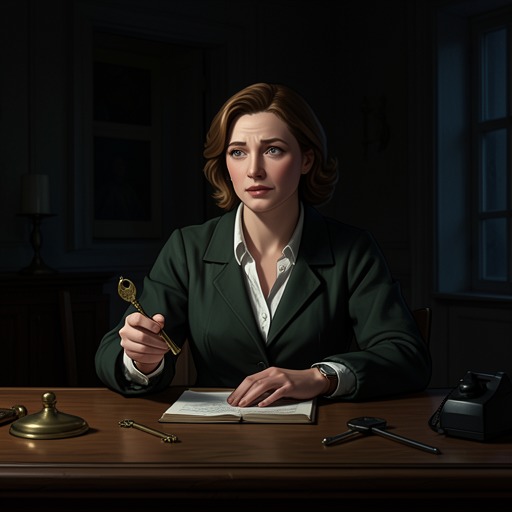
Helen Tells Jake About Nathan
Happiness for BeginnersHelen’s account of Nathan’s death is a turning point in her conversation with Jake: she moves from naming the brother she lost to confronting how grief, guilt, and resentment shaped her relationship with Duncan. The disclosure does not undo the drowning or erase Helen’s regret, but it gives her a new way to understand the family that formed around the loss—and the brother she had long treated as its cause.
The Choice to Tell the Truth
The disclosure begins with a question about whom Helen turns to when she feels shaken. Jake names his mother; Helen says her brother. When Jake assumes she means Duncan, Helen recognizes that she could accept the assumption and conceal what she has just revealed. Instead, in the quiet of the night, with the two of them awake beside the sleeping group, she tells him that she means her other brother, Nathan. The closeness and whispered conversation make the moment feel safe enough for a truth she has rarely spoken.
Jake already knows that Helen was close to a brother who died the year before Duncan was born. But she confirms that the death was a drowning and then chooses to give him the circumstances rather than stop at the fact. She describes being at her parents’ friends’ lake house, where the adults were drinking and a group of children were meant to watch a movie. Nathan wanted to go to the marina and run on the docks. He begged Helen to take him; she did not want to go. He left on his own without telling the others.
Helen recalls the ordinary choice that now carries the weight of regret: she wanted to watch the movie. Yet the movie’s title has disappeared from her memory. She says she sometimes lies awake looking at the fan and tries to recover that detail, and has considered asking the other children who were there whether any of them remembers. The contrast is stark: the circumstances surrounding Nathan’s death remain vivid, but one seemingly minor piece of the evening is missing. Telling Jake means exposing both what she remembers and the blank she cannot fill.
Guilt and the Family After the Drowning
Jake tells Helen that Nathan’s death was not her fault. She answers from the position she has occupied for years: she was the big sister. His reassurance cannot simply dissolve that belief. Helen understands that a sibling is not a parent and that regret cannot change the past, yet she has continued to hold on to blame as though letting it go would be indecent. Her response shows that the guilt is not just a mistaken conclusion she can discard; it has become part of how she keeps faith with the lost child.
She also describes what followed at home. Her mother searched frantically at the lake and remained unable to stop looking even after Nathan was found in the water. At home, she woke night after night and paced. Two months after the death, she became pregnant. Helen believes the pregnancy was deliberate, an attempt to replace the child they had lost, but insists that Nathan was irreplaceable. The account holds the family’s hope and its impossibility together: Duncan’s birth followed the loss, but it could not reverse it.
The timing of the births shaped Helen’s understanding of Duncan long before she could see the wider causes of her family’s distress. She recalls that, as a ten-year-old, she blamed him for her father’s disappearance, her mother’s worsening condition, and the neglect she felt. Duncan’s needs seemed to compound the burden: he was a colicky baby, then an exhausting toddler, then a mischievous child. Grandma GiGi loved the children but had little tolerance for them, so Helen began babysitting constantly at thirteen and continued until she left for college. Leaving brought relief, and distance allowed her to treat her resentment as settled rather than revisit its origins.
Reconsidering Duncan and the Past
While talking with Jake, Helen arrives at a more uncomfortable explanation: she has not forgiven Duncan for not being Nathan. Hearing herself articulate this changes the direction of the memory. Duncan had not asked to be born, and he entered the same family upheaval as Helen. She can now see him as a motherless child, starved for attention even from his sister, and understand that his behavior—including stealing Grandma GiGi’s car at eight—was one way of trying to get it.
This altered perspective does not declare Helen’s childhood easy or make her old feelings disappear. She still remembers being left to care for Duncan, feeling ignored, and wanting to escape. What changes is the assignment of blame. She sees her mother as overwhelmed by grief, guilt, and regret, and her father as burying his sorrow in work and unable to help. She also acknowledges that she might have left if she had been able to, while she had to stay with a family whose deepest loss could not be repaired by anyone still present. Nathan’s absence, not Duncan’s birth, is the central fact around which the household’s pain gathered.
The Disclosure’s Place in Helen and Jake’s Story
Jake’s role in the conversation is to listen and offer a different account of responsibility. He does not deny what Helen endured; he challenges the belief that a child’s failure to take charge of another child made her responsible for the drowning. His presence makes the remembered event speakable, but the insight that follows belongs to Helen: she recognizes how her guilt about Nathan was displaced onto Duncan and how long that explanation went unexamined.
The exchange also sits within a developing pattern of difficult disclosures between them. Jake has just advised Helen to get in touch with her person, and the moment leads her to identify the brother she had not been discussing. Elsewhere in their conversations, Jake tells her that he has an inherited vision disorder that cannot be fixed, that his sight will eventually go dark, and that the future he had imagined—including becoming a doctor and having children—feels as though it is disappearing. He later explains that once he knew the diagnosis for certain, he could not eat or breathe, and that he had come to Helen to be brave enough to tell her he could not leave her alone. These disclosures are not the same event as Helen’s account of Nathan, but they illuminate the trust their conversations require: each gives the other access to a fear that has shaped a private life.
Helen’s telling does not offer a simple release from grief. Nathan remains irreplaceable, and the past remains beyond correction. Its consequence is more precise: she can begin to distinguish the brother she lost from the brother who was born afterward, and to see Duncan as a child caught in the same family tragedy rather than its author.